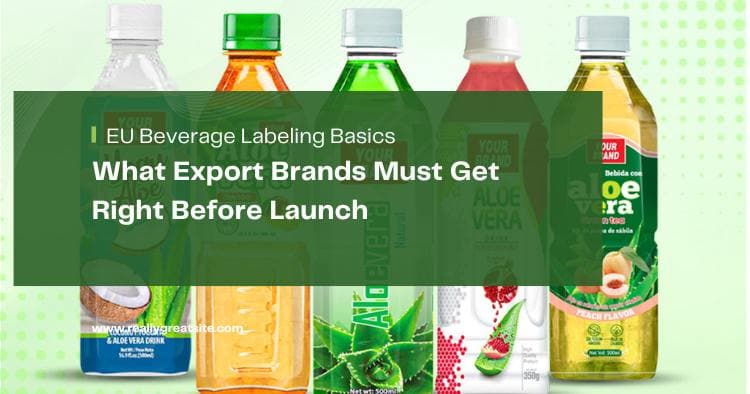
Entering the EU Market: Why Beverage Labeling is a Commercial Priority
For international beverage distributors and importers, the European Union represents a high-value market. However, navigating the EU’s strict food information regulations can be a significant hurdle. Getting your beverage labeling right before launch is not just a legal requirement it is a critical commercial strategy to prevent customs delays, avoid costly product recalls, and build immediate trust with European consumers.
At VINUT, we understand that regulatory compliance is a shared priority. To help our B2B partners streamline their import process, we have outlined the fundamental EU beverage labeling requirements every export brand must master.
1. The Essential EU Beverage Labeling Checklist

Under the EU Food Information to Consumers (FIC) Regulation, beverage labels must be clear, accurate, and easy to understand. For B2B buyers, ensuring these elements are correct before shipping saves time and capital.
Here is the core checklist for EU-bound beverages:
| Regulatory Requirement | Description & Application |
|---|---|---|
| 1 | Exact Legal Name of the Beverage | Marketing names are not enough. The label must clearly state what the product is (e.g., “Coconut Water with Pineapple Juice”) so consumers are not misled. |
| 2 | Comprehensive Ingredient List | All ingredients must be listed in descending order of weight. Importantly, any of the 14 major EU allergens must be visually highlighted (for example, in bold text). |
| 3 | Quantitative Ingredient Declaration (QUID) | If a specific ingredient is emphasized on the packaging (such as “Aloe Vera” or “Mango”), its exact percentage must be stated in the ingredient list. |
| 4 | Net Quantity | The net quantity must be expressed using the metric system in liters (L), centiliters (cl), or millilitres (ml). |
| 5 | Date of Minimum Durability | Clearly display the “Best before” or “Use by” date following the standard European format. |
| 6 | Storage and Usage Conditions | Provide clear instructions if special storage conditions are required (e.g., “Refrigerate after opening and consume within 3 days”). |
| 7 | Food Business Operator (FBO) Details | The packaging must include the name and physical address of the manufacturer, packer, or EU-based importer. |
| 8 | Country of Origin | This is mandatory if the absence of origin information could mislead consumers, and it is specifically required for certain beverage categories. |
| 9 | Nutritional Declaration | A standardized nutrition table must show: Energy value Fat Saturates Carbohydrates Sugars Protein Salt All values must be provided per 100 ml. |
2. Language and Localization Requirements
One of the most common pitfalls for export brands is language compliance. The EU is a multilingual market and mandatory food information must appear in the official language(s) of the specific Member State where the beverage is sold.
Multi-language labels are permitted and highly recommended for brands targeting multiple European markets simultaneously, as they help maximize inventory flexibility and reduce relabeling costs.
3. Partnering with an Export-Ready Manufacturer
Regulatory compliance should not slow down your speed to market. Partnering with an experienced international beverage manufacturer like VINUT ensures that your products are designed with global standards in mind from day one.
Our export teams work closely with distributors to ensure that product specifications, ingredient profiles, and packaging formats align with EU expectations, helping mitigate regulatory risks and accelerate market entry.
Ready to expand your beverage portfolio in Europe?
Explore our export-ready Beverage Categories or contact our global distribution team today to discuss your market needs.