
How U.S. Buyers Evaluate Coconut Water Brands
The strongest coconut water brand is not automatically the one with the lowest price, the most flavors, or the most attractive packaging.
U.S. importers, distributors, and retailers evaluate whether a brand can fill a clear role in the market, meet regulatory requirements, generate acceptable margins, maintain product consistency, support repeat orders, and create enough consumer demand to justify shelf space.
This evaluation has become more important as the category grows and competition intensifies. A July 2026 presentation from The Vita Coco Company, based on company-commissioned Circana research, estimated the U.S. coconut water category at approximately USD 1.6 billion, with year-to-date growth of approximately 29% as of June 28, 2026. Separately, Vita Coco reported more than 40% U.S. category share for the 52 weeks ending December 28, 2025. These figures suggest a growing but concentrated market in which new brands need a clear reason to be selected.
Buyer’s core question: Can this brand create incremental, profitable, and repeatable sales without introducing avoidable compliance, quality, or supply risk?
This guide explains the criteria buyers use and provides a practical evaluation scorecard.

U.S. Buyers Are Not One Audience
Different buyers evaluate the same coconut water brand from different perspectives.
Buyer type | Primary question | Main evaluation focus |
| Importer | Can the product enter the United States compliantly? | FDA documentation, FSVP support, customs, labeling and shipment records |
| Distributor | Can the product move through our network and reorder? | Demand, margins, shelf life, case configuration, inventory and service |
| Retail category buyer | Will it improve category sales and profitability? | Differentiation, velocity, retail margin, shelf productivity and consumer fit |
| Natural or specialty retailer | Does it match our product standards and shopper expectations? | Ingredients, organic status, sourcing story, claims and premium positioning |
| Convenience retailer | Will it sell quickly from the cold box? | Single-serve format, price point, immediate product recognition and rate of sale |
| Club or warehouse buyer | Does the multipack offer clear value? | Pack economics, case strength, household usage and inventory turnover |
| E-commerce buyer | Can it ship profitably without excessive damage? | Multipack configuration, weight, dimensional cost, packaging and reviews |
| Foodservice buyer | Is the product operationally practical? | Case size, handling, serving format, consistency and menu application |
A brand presentation should therefore be adapted to the target channel rather than sending every buyer the same generic company profile.
1. Does the Brand Have a Clear Role in the Category?
The first commercial test is not whether the drink tastes good. It is whether the buyer understands why the brand deserves a place in the assortment.
A strong proposition identifies:
- The target consumer
- The primary usage occasion
- The product tier
- The intended channel
- The reason consumers would switch or add the product
- The difference from products already available
Common Coconut Water Positions
Position | Possible role | Buyer concern |
| Accessible 100% coconut water | Everyday hydration at a competitive price | Is the product sufficiently differentiated from market leaders and VINUT branded distribution? |
| Premium coconut water | Higher-quality taste, origin, process or packaging | Is the premium price supported by a recognizable consumer benefit? |
| Flavored coconut water | Easier category entry for consumers unfamiliar with plain coconut water | Does flavor improve trial without weakening the coconut water proposition? |
| Organic coconut water | Natural and specialty retail positioning | Is the certification valid and can the target shopper support the price? |
| Functional hydration | Coconut water combined with electrolytes or other functions | Are the claims lawful, measurable and commercially meaningful? |
| Family-size format | At-home consumption, smoothies and meal occasions | Will the product maintain quality after opening and justify shelf space? |
| Multipack | E-commerce, club and repeat household consumption | Does the pack deliver value after freight, fulfillment and promotional costs? |
A brand that claims to be suitable for every consumer and every channel usually lacks a focused market strategy.
Questions Buyers Ask
- Who is the primary consumer?
- What occasion does the product own?
- Which existing item would it replace or complement?
- Is the product mainstream, premium, organic, functional, or value-led?
- Why would a shopper choose it again after the first trial?
- Which one or two SKUs should lead the launch?
Buyers generally prefer a disciplined launch portfolio over a large catalog without clear SKU priorities.
2. Is the Product Proposition Factually Clear?
The front of the package, technical specification, ingredient list, Nutrition Facts panel, sales presentation, and website should all describe the same product.
The buyer must be able to determine whether the item is:
- 100% coconut water
- Coconut water from concentrate
- Not-from-concentrate coconut water
- Coconut water with added ingredients
- Flavored coconut water
- Coconut water blended with fruit juice
- A coconut juice drink
- A functional beverage containing coconut water
FDA regulations require beverages represented as containing fruit or vegetable juice to use an appropriate percentage juice declaration. If a 100% juice product contains certain non-juice ingredients, the declaration may need additional wordin

Product Claims Buyers Verify
Claim or description | Evidence the buyer should review |
| 100% coconut water | Complete formula, ingredient list, product identity and percentage juice declaration |
| From concentrate | Reconstitution method, formula, finished-product specification and label wording |
| Not from concentrate | Processing description and supporting production records |
| No added sugar | Formula, ingredient functions, Nutrition Facts and compliance review |
| Sugar free | Laboratory or validated nutrition data demonstrating the regulatory threshold |
| Organic | Current certificate, certified facility, product scope and certifier-approved artwork |
| Natural | Ingredient and processing basis for the claim |
| Electrolytes | Measured nutrient levels and basis for any nutrient or performance claim |
| Hydration | Wording, intended consumer interpretation and supporting substantiation |
| Flavored coconut water | Coconut water content, flavor source, added fruit juice, sweeteners and percentage juice statement |
“No Added Sugar” Does Not Mean “Sugar Free”
Coconut water naturally contains sugars. A product may qualify for a “no added sugar” claim while still declaring total sugars in the Nutrition Facts panel.
Under 21 CFR 101.60, “no added sugar” and similar terms may be used only when sugars or ingredients that functionally substitute for added sugars have not been added and the other applicable conditions are met. Total sugars and added sugars are separate declarations under U.S. nutrition labeling rules.
Buyers therefore compare the front-of-pack claim with:
- Total sugars per serving
- Added sugars per serving
- Ingredient list
- Serving size
- Calories
- Any required qualifying statement
An attractive claim that creates a misleading overall impression can become a regulatory and retailer risk.
3. Does the Product Deliver Consistent Taste?
One favorable sample is not sufficient evidence of commercial consistency.
Coconut water can vary according to raw-material source, maturity, season, formulation, processing, storage conditions, and packaging. Buyers need to understand whether the product supplied in the second, fifth, and tenth orders will remain within the approved sensory profile.
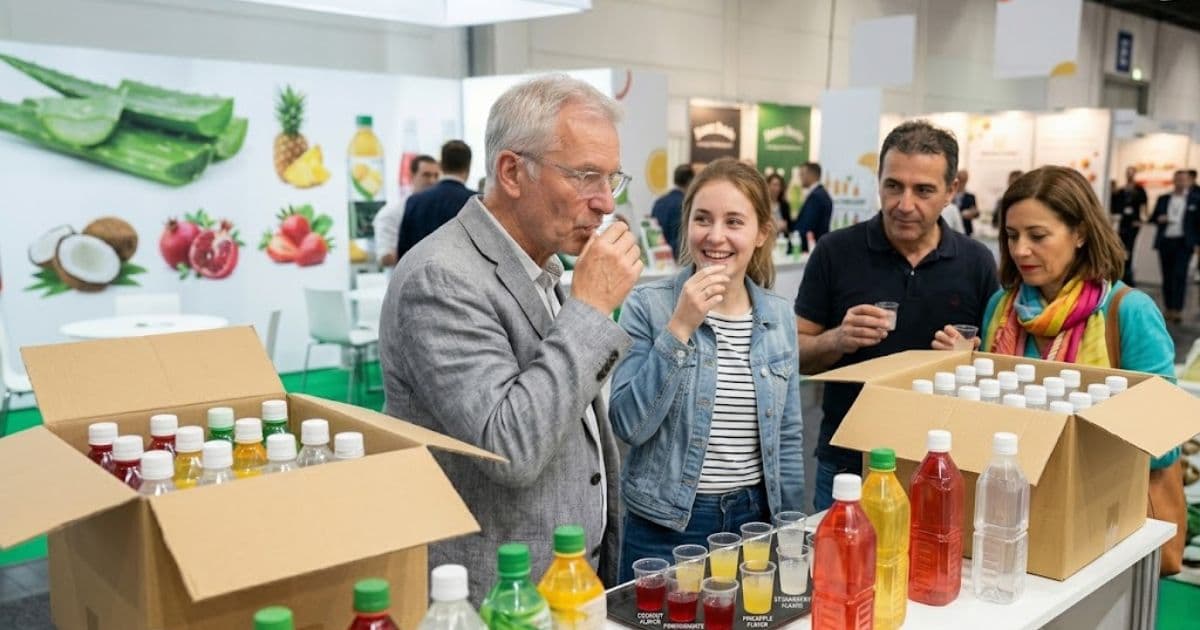
Recommended Sensory Evaluation
Attribute | What the buyer evaluates | Possible warning signs |
| Aroma | Fresh and recognizable coconut character | Fermented, stale, metallic or heavily cooked notes |
| Sweetness | Balanced sweetness appropriate to the proposition | Excessively sweet, weak or inconsistent between samples |
| Acidity | Clean and balanced finish | Harsh, sour or unbalanced taste |
| Coconut character | Natural and identifiable flavor | Artificial, diluted or masked profile |
| Color | Consistency with the approved standard | Unexpected darkening, cloudiness or major lot variation |
| Mouthfeel | Clean, smooth and suitable for the format | Watery, heavy, gritty or inconsistent texture |
| Aftertaste | Pleasant finish that supports repeat consumption | Bitter, metallic, chemical or lingering artificial notes |
Practical Sample Protocol
A professional evaluation should include:
- Blind-coded samples from several suppliers
- Samples served at the same temperature
- At least three production lots where commercially feasible
- Corresponding certificates of analysis
- Comparison against the agreed product specification
- A landed sample after international transport
- Retained samples for future complaint investigation
Buyers may review Brix, pH, color, microbiological limits, nutrient values, fill volume, seam or closure integrity, and other specification parameters. However, technical measurements should support rather than replace sensory approval.

The “Golden Sample” Risk
A golden sample is a specially prepared or unusually favorable sample that is not representative of routine commercial production.
The approved reference sample should therefore be connected to:
- A production lot number
- Production date
- Formula version
- Finished-product specification
- Certificate of analysis
- Packaging configuration
- Agreed sensory standard
The supplier should also explain how the reference standard will be maintained across repeat orders.
4. Can the Brand Support U.S. Compliance?
Compliance is normally a pass-or-fail gate. A strong design, competitive price, or popular flavor cannot compensate for a materially non-compliant product.
FDA Registration Is Not Product Approval
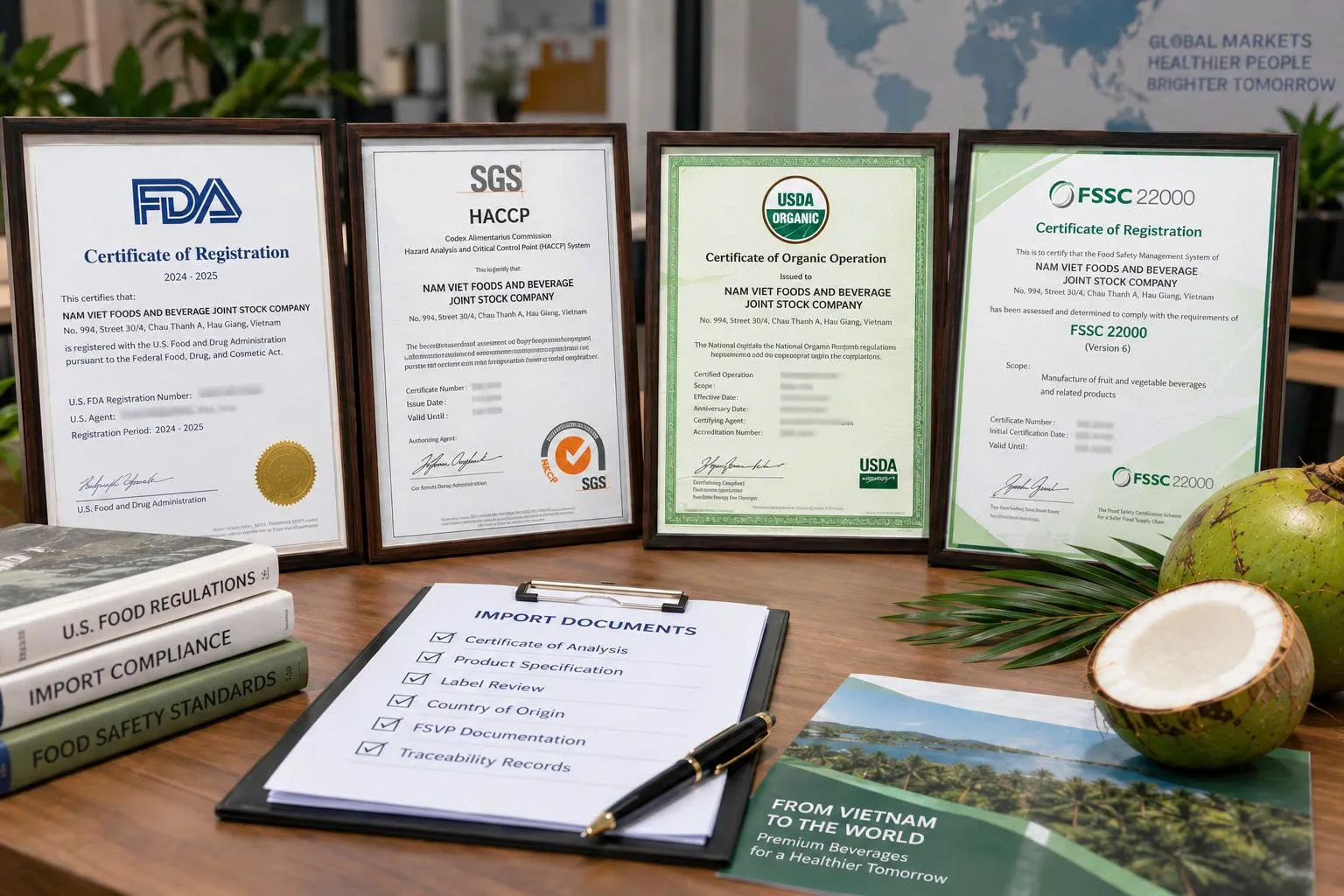
FDA does not pre-approve or certify individual imported foods, labels, importers, or shipments. Applicable foreign facilities may need FDA registration, and Prior Notice must be submitted for incoming food shipments.
Statements such as the following should be treated cautiously:
- Quality Documentation Available on Request coconut water
- Quality Documentation Available on Request product
- FDA-approved factory quality
- FDA-approved label
Facility registration is not confirmation that FDA has approved the brand or product.
FSVP Support
Unless an exemption applies, the U.S. FSVP importer must develop and follow a verification program for each imported food and foreign supplier. The program is intended to verify that imported food is produced according to applicable U.S. safety requirements.
Although the regulatory responsibility rests with the FSVP importer, the foreign supplier must be capable of providing relevant information, including:
- Product and process descriptions
- Hazard analysis support
- Food safety plans
- Audit reports
- Corrective-action records
- Certificates of analysis
- Traceability documentation
- Supplier approval information
- Recall and complaint procedures
A supplier that cannot provide timely and product-specific evidence creates additional cost and risk for the importer.
Juice HACCP
FDA guidance treats liquid extracted from coconut, including coconut water, as juice for the purpose of the Juice HACCP regulation.
Buyers should confirm that the selected product and process are properly addressed by the supplier’s HACCP system rather than accepting a general certificate that may cover a different line or product group.
Organic Claims
Products represented as “organic” generally require at least 95% Product documentation available on request content. Organic product labels must be reviewed and approved by a USDA-accredited certifying agent before use.
The buyer should verify:
- Certificate validity
- Certified operation
- Product scope
- Ingredient status
- Handling facility
- Certifying agent
- Approval of the actual U.S. artwork
An EU, Vietnamese, or private organic certificate should not automatically be assumed to authorize use of the USDA Organic seal.
Health and Performance Claims
Marketing claims must be truthful and appropriately substantiated. The FTC does not pre-approve health claims, but it expects advertisers to possess adequate scientific support before making objective health-related representations.
High-risk wording may include unsupported claims such as:
- Prevents dehydration
- Rehydrates faster than water
- Detoxifies the body
- Improves immunity
- Treats fatigue
- Restores mineral deficiencies
- Clinically proven hydration
Buyers may reject claims even before determining whether they are technically unlawful because the language creates unnecessary legal, retailer, and reputation exposure.
Country-of-Origin Marking
Foreign-origin articles entering the United States generally must be marked legibly with the English name of the country of origin.
The brand should verify that the consumer unit, outer case, customs documents, and digital listings use consistent origin information.
5. Is the Product Retail-Ready?
A technically compliant beverage is not automatically ready for retail distribution.
Retail readiness covers the complete system required to list, receive, store, sell, replenish, and promote the product.
Consumer Unit
The buyer reviews:
- Product name
- Brand visibility
- Flavor identification
- Net contents
- Ingredients
- Nutrition Facts
- Juice percentage
- Required claims and qualifiers
- Manufacturer, packer, or distributor statement
- Country of origin
- Lot and date coding
- UPC or other required barcode
- Artwork legibility
- Closure and tamper evidence where applicable
The front panel should communicate the product type quickly. Buyers may consider a package commercially weak when consumers cannot distinguish between coconut water, coconut juice drink, flavored water, and a juice blend.
Barcode and Product Identification
GS1 standards use GTINs to identify trade items, with UPC barcodes commonly used on grocery products sold in the United States. Buyers should verify that identifiers correspond to the correct brand owner, product size, flavor, and pack configuration.
A different consumer unit, multipack, or case configuration may require separate product identification.
Brands should also prepare for the broader retail transition toward two-dimensional barcodes under the GS1 Sunrise 2027 initiative.
Shipping Case
The master carton should provide:
- Product and flavor
- Units per case
- Unit size
- Lot or production code
- Best-by or expiration information
- Gross and net weight
- Case dimensions
- Country of origin
- Case barcode
- Handling instructions
- Importer or distributor information when required
- Pallet configuration
Cases must be assessed under the actual intended distribution conditions, not only under short domestic transport.
Shelf-Life Readiness
Buyers evaluate remaining shelf life at the point of receipt, not only the total shelf life printed in the specification.
For example, UNFI’s supplier terms published in July 2026 state that products should retain at least 75% of their shelf life when received at the applicable distribution center unless otherwise agreed in writing. This is a specific distributor requirement, not a universal U.S. rule, but it demonstrates how channel requirements can exceed the legal minimum.
A buyer may calculate:
Remaining shelf life at receipt
= Total validated shelf life
− Production and release time
− Export preparation
− Ocean transit
− Customs and port handling
− Domestic transport
− Distribution-center receiving time
A 24-month stated shelf life may be commercially unattractive if a significant portion has already been consumed before the product reaches the retailer.
6. Do the Commercial Economics Work?
U.S. buyers do not evaluate FOB price in isolation.
They evaluate the cost of placing one saleable unit into the required warehouse, distribution center, store, or consumer order.
Landed Cost Formula
Landed cost per unit = FOB case price
- international freight
- cargo insurance
- applicable duty or tariff
- customs brokerage
- port and drayage charges
- domestic freight
- warehouse and handling charges ÷ saleable units per case
The calculation may also need to account for:
- Broker commission
- Distributor margin
- Retailer margin
- Promotional allowances
- Free fills or introductory discounts
- Sampling
- Slotting or new-store setup fees where applicable
- Returns, damages and expiry
- Chargebacks and deductions
- E-commerce fulfillment
- Marketplace fees
- Currency and freight fluctuations
Retailer Gross Margin
Retailer gross margin percentage = Retail price − retailer acquisition cost ÷ retail price × 100
A proposed retail price must also make sense relative to:
- Category leaders
- Private-label alternatives
- Pack size
- Ingredient proposition
- Premium or organic positioning
- Consumer willingness to pay
- Promotional price expectations
Brand Contribution
A brand should model its own contribution after deductions:
Net contribution = Net invoiced revenue
− cost of goods
− logistics
− commissions
− trade spending
− deductions
− expected claims and damages
A low FOB quote may still produce an uncompetitive retail price once all channel costs are included.
Questions Buyer Ask
- What is the recommended retail price?
- What margin does the retailer receive?
- What margin does the distributor receive?
- Is a broker included?
- Who funds promotions and samples?
- How does the price compare per fluid ounce?
- Is the multipack cheaper per unit than the single can?
- Can pricing remain stable for the agreed period?
- What happens if ocean freight changes?
- Is there sufficient margin to support repeat promotions?
7. Can the Supplier Support Repeat Orders?
The commercial value of a supplier is demonstrated after the first shipment.
Buyers assess whether the brand and its production partner can replenish inventory with the same formula, packaging, quality, and documentation.
Supply Evaluation
Area | Buyer question | Evidence |
| Capacity | What is the realistic monthly capacity for the selected SKU and pack? | Line capacity, production schedule and existing commitments |
| Lead time | How long from confirmed order to shipment? | Standard timeline with approval and production stages |
| MOQ | Can the order quantity match the launch plan? | MOQ by SKU, artwork and packaging format |
| Forecasting | How much notice is required for repeat orders? | Forecast calendar and material planning requirements |
| Raw materials | How is seasonal availability managed? | Sourcing plan, approved suppliers and contingency arrangements |
| Packaging components | Are cans, ends, bottles, caps, labels and cartons secured? | Component lead times and backup options |
| Quality release | Who approves finished goods for shipment? | QA release procedure and COA |
| Traceability | Can each unit be linked to production and raw-material records? | Lot-coding and traceability exercise |
| Recall readiness | Can affected lots be identified and controlled quickly? | Recall plan, contacts and mock-recall records |
| Complaint handling | Who investigates U.S. complaints? | Response timeline and corrective-action process |
| Communication | Who owns the account after the order? | Named commercial, quality and logistics contacts |
Major retailers may impose audits, inspections, testing, responsible-sourcing requirements, and access to supplier records beyond basic legal compliance. Walmart, for example, states that suppliers may need food-safety and other audits and must make products, facilities, and records available for relevant inspections and testing.
Repeat-Order Performance
Buyers may track:
- On-time shipment
- Order completeness
- Documentation accuracy
- Product-release delays
- Damage rate
- Lot consistency
- Complaint frequency
- Response time
- Replenishment lead time
- Forecast adherence
Reliable repeat-order execution often creates more long-term value than a marginally lower first-order price.
8. Is There Credible Evidence of Consumer Demand?
A buyer needs evidence that the brand can sell through to consumers, not only sell into a distributor.
Sell-In Versus Sell-Through
Sell-in measures products shipped to a distributor or retailer.
Sell-through measures products purchased by the final consumer.
A large initial shipment is not proof of sustainable consumer demand if inventory remains in warehouses or stores.
Evidence Hierarchy
Evidence | Relative strength |
| Retail scan or POS data with time period and store count | Strong |
| Units sold per store per week | Strong |
| Repeat retailer or distributor orders | Strong |
| Sustained e-commerce sales and repeat purchase | Moderate to strong |
| Documented promotional lift and post-promotion baseline | Moderate to strong |
| Confirmed distribution with active store count | Moderate |
| Consumer research or controlled market test | Moderate |
| Marketplace reviews without verified sales context | Limited |
| Social followers and impressions | Limited |
| Trade-show inquiries | Early signal only |
| Unsupported claims of global leadership | Weak |
Data Buyers Expect
A credible sales presentation should define:
- Market and geography
- Measurement period
- Number of active stores
- Number of SKUs
- Units per store per week
- Average selling price
- Promotional periods
- Repeat-order rate
- Out-of-stock periods
- Source of the data
Statements such as “sold nationwide” or “available in thousands of stores” are less useful when they do not state the period, number of active doors, or actual sales velocity.
Brands Without U.S. Sales History
A new international brand can still be considered when it provides a controlled market-entry plan.
The plan should identify:
- Launch region
- Target channel
- Hero SKU
- Initial account profile
- Trial order
- Consumer sampling
- Promotional calendar
- Digital support
- Sales KPIs
- Inventory exit plan
- Criteria for expansion
A realistic pilot is more credible than an unsupported national rollout proposal.
9. Can the Brand Support the Launch?
The importer or distributor should not be expected to create the brand strategy, retail materials, product education, and consumer demand alone.
Minimum Brand-Support Package
A retail-ready brand should be capable of providing:
- U.S.-appropriate brand presentation
- Product sell sheets
- Accurate product photography
- Packaging renders
- Ingredient and nutrition information
- Retailer presentation deck
- Product data in editable format
- Website product pages
- Social media content
- Consumer FAQs
- Sales training
- Sampling materials
- Promotional calendar
- Trade-show support
- Customer-service process
- Approved claim library
Channel Governance
Buyers may also evaluate:
- Territory authorization
- Distributor roles
- Marketplace authorization
- Amazon seller control
- Pricing consistency
- Unauthorized resellers
- Channel conflict
- Ownership of consumer data
- Use of trademarks and digital assets
Uncontrolled marketplace activity can undermine retailer pricing and distributor confidence even when the physical product is acceptable.
10. How Evaluation Changes by Channel
Channel | Most important criteria |
| Mass grocery | Clear category role, mainstream appeal, margin, velocity, supply capacity and promotional support |
| Natural and specialty | Ingredient quality, organic status, sourcing story, product differentiation and claim credibility |
| Convenience | Single-serve size, cold-box visibility, immediate recognition, fast consumption occasion and unit velocity |
| Ethnic grocery | Flavor relevance, brand familiarity, value, regional distributor access and assortment breadth |
| Club and warehouse | Multipack value, household usage, high-volume capacity, case integrity and efficient palletization |
| E-commerce | Pack durability, dimensional cost, fulfillment economics, content quality, ratings and repeat purchase |
| Foodservice | Case economics, storage, portioning, service speed, consistency and menu compatibility |
| Fitness and wellness | Product composition, sugar profile, hydration positioning, claim substantiation and cold availability |
A product should not be presented as “ideal for all channels” without explaining the format, price, and operating model for each channel.
11. Coconut Water Brand Evaluation Scorecard
The following 100-point framework is a recommended commercial tool. It is not an official U.S. regulatory or retail-industry standard.
Pass-or-Fail Gates
Before applying the score, confirm that the brand passes these minimum conditions:
Gate | Minimum condition |
| Product identity | Formula, product name and label are materially consistent |
| Food safety | Acceptable product-specific food-safety documentation |
| FSVP support | Supplier can provide information required by the importer |
| Labeling | No unresolved material U.S. label issue |
| Claims | Claims are supportable and appropriately worded |
| Economics | Target channel can achieve the required margin |
| Shelf life | Sufficient remaining life at expected receipt |
| Traceability | Lot coding and recall capability are demonstrated |
A failure in a critical compliance or safety gate should not be offset by a high marketing score.
Weighted Score
Evaluation area | Weight | Key factors |
| Category and consumer fit | 15 | Target consumer, occasion, differentiation, channel fit and SKU discipline |
| Product and sensory quality | 15 | Formula clarity, taste, consistency, specification and shelf-life validation |
| Regulatory and food safety | 20 | Label, claims, HACCP, FSVP support, traceability, audits and certification scope |
| Packaging and retail readiness | 10 | Artwork, barcode, cases, pallet data, date codes and master data |
| Commercial economics | 15 | Landed cost, margin, MSRP, trade spending and price architecture |
| Supply and service reliability | 15 | Capacity, MOQ, lead time, forecasting, contingency and complaint handling |
| Demand evidence and launch support | 10 | Sales data, repeat orders, pilot plan, marketing assets and account support |
| Total | 100 |
Suggested Decision Thresholds
Score | Recommendation |
| 80–100 | Strong shortlist candidate, subject to final verification |
| 65–79 | Conditional pilot with documented corrective actions |
| 50–64 | Significant remediation required before launch |
| Below 50 | Do not proceed without major changes |
The buyer should record the evidence supporting each score rather than relying on subjective impressions.
12. Common Red Flags
Red flag | Why it matters |
| “Quality Documentation Available on Request” product claim | FDA does not pre-approve individual conventional food products or labels |
| One general certificate for every SKU | The certificate may not cover the product, facility, line or process being offered |
| Only one specially prepared sample | It does not demonstrate repeat-production consistency |
| Product name conflicts with ingredient list | Creates labeling, consumer-trust and retailer risk |
| “No added sugar” presented as “sugar free” | Can mislead consumers about naturally occurring sugars |
| Organic logo without product-level verification | May not satisfy USDA certification and labeling requirements |
| Unverified barcode ownership | Can cause listing, product-data and marketplace conflicts |
| Long shelf-life claim without supporting validation | Does not demonstrate stability under actual distribution conditions |
| Very large portfolio without a hero SKU | Suggests weak launch discipline and fragmented inventory |
| FOB-only commercial proposal | Ignores the buyer’s landed cost and channel margin |
| No FSVP documentation support | Increases importer compliance burden |
| Unsupported hydration or health claims | Creates FDA, FTC and retailer exposure |
| Vague statements about global sales | Do not demonstrate current consumer demand |
| Immediate demand for national exclusivity | May create risk before performance has been proven |
| Different formula for the sample and order | Invalidates sensory and commercial approval |
| Frequent changes to label, size or formula | Disrupts listings, inventory, barcodes and consumer recognition |
13. Recommended Buyer Evaluation Process
Stage | Main activity | Required output |
| 1. Commercial brief | Define consumer, channel, format, target price and annual potential | Written sourcing brief |
| 2. Initial screening | Review brand, formula, documentation, certifications and indicative pricing | Shortlist |
| 3. Product validation | Conduct blind tasting and specification review across representative lots | Approved product profile |
| 4. Compliance review | Review label, claims, HACCP, FSVP support and import documentation | Issue and action register |
| 5. Financial modeling | Calculate landed cost, margins, promotions and working capital | Channel P&L |
| 6. Operational review | Verify capacity, lead time, cases, pallets, barcodes and replenishment | Supply plan |
| 7. Controlled pilot | Launch limited SKUs, regions, stores or accounts | Pilot performance data |
| 8. Post-launch review | Evaluate velocity, repeat orders, inventory, complaints and margin | Scale, revise or discontinue decision |
The process should preserve a documented audit trail showing who approved the formula, artwork, sample, specification, and commercial terms.
Where VINUT Fits
VINUT presents coconut water as part of its international beverage portfolio for importers, distributors, retailers, and trade partners. Its public product catalog includes canned and bottled coconut water products, as well as pure and flavored variations.
For a U.S. buyer, the public catalog should be treated as the beginning of the evaluation rather than the complete approval package.
The buyer should request information for the exact selected SKU:
- Signed product specification
- Complete ingredient and nutrition information
- U.S. label artwork
- Product-specific shelf-life information
- Representative samples
- Recent certificates of analysis
- Applicable certificates and audit scope
- Case and pallet configuration
- Barcode information
- MOQ
- Production lead time
- Commercial quotation
- Territory availability
- FSVP support documents
VINUT should be evaluated as the market-facing beverage brand. Buyers should separately verify the legal manufacturer, exporter, facility, and other entities named in technical, customs, and regulatory documents.
A strong VINUT proposal should lead with:
- A clearly defined hero SKU
- A specific target channel
- Product and sensory evidence
- U.S. retail economics
- Reliable replenishment
- A controlled launch plan
Frequently Asked Questions
What do U.S. buyers check first when evaluating a coconut water brand?
Commercial buyers initially assess whether the brand has a clear consumer, category role, target channel, and price position. Regulatory, food-safety, and documentation requirements then operate as mandatory approval gates.
Is taste the most important factor?
Taste is essential for trial and repeat consumption, but it is only one part of the decision. A good-tasting product may still be rejected because of poor margins, unclear labeling, inadequate shelf life, unreliable supply, or insufficient demand support.
Does FDA approve coconut water brands?
No. FDA does not pre-approve individual imported food products, brands, labels, or shipments. Facilities, importers, processes, labels, and shipments must comply with the applicable requirements.
Is coconut water subject to Juice HACCP?
FDA guidance considers coconut water to be juice for purposes of the Juice HACCP regulation. Buyers should verify that the actual product and process are appropriately covered.
Does 100% coconut water always perform better than flavored coconut water?
No. Performance depends on the target consumer, channel, price, brand recognition, taste, and consumption occasion. Plain coconut water may appeal to established category users, while flavored products may reduce the taste barrier for new consumers.
How many SKUs should a brand launch?
There is no universal number. A controlled launch usually benefits from one clear hero SKU and a limited number of extensions. Additional products should be introduced when sales data demonstrates a specific assortment opportunity.
Is a 24-month shelf life automatically sufficient?
No. Buyers evaluate remaining shelf life at the expected point of receipt. Production, export preparation, ocean transit, customs, domestic transport, and distribution-center processing all reduce the usable selling period.
What is the strongest proof of market demand?
Retail POS or scan data, units per store per week, repeat orders, stable post-promotion sales, and documented distribution are generally more useful than social impressions, unsupported store-count claims, or one-time shipments.
Does organic certification guarantee retail acceptance?
No. Certification supports the organic claim, but the brand must still meet the buyer’s requirements for taste, margin, differentiation, supply, packaging, and consumer demand.
Conclusion
U.S. buyers do not select coconut water brands from packaging or price alone.
They evaluate whether the brand can deliver a complete commercial system:
- A clear role in the category
- A truthful and differentiated product proposition
- Consistent sensory quality
- Compliant labels and supportable claims
- Appropriate food-safety and importer documentation
- Retail-ready packaging and product data
- Competitive landed economics
- Reliable repeat-order supply
- Credible evidence of demand
- A practical channel launch plan
The most attractive brand is therefore not simply the product that looks best during the presentation. It is the brand that reduces uncertainty for the importer, distributor, retailer, and final consumer.
For buyers evaluating VINUT Coconut Water, the recommended next step is to request the current coconut water portfolio, selected-SKU specification, packaging data, samples, commercial terms, MOQ, lead time, and market availability.