
European buyers rarely evaluate a beverage product based on taste alone. In practice, product quality signals in European trade are formed through a combination of visible consistency, documentation, and operational reliability. These signals help buyers decide whether a supplier is trustworthy before deeper commercial engagement.
The Strategic Role of Product-Quality-Signals in European Trade
Before requesting samples or visiting factories, buyers often assess brands through websites, product sheets, and catalogs. Clear and structured information reduces uncertainty. Weak or inconsistent presentation, on the other hand, can delay decisions or stop conversations entirely. Strong quality signals shorten evaluation time and increase buyer confidence from the first interaction (see Building a Balanced Tropical Beverage Portfolio).
Operational Consistency: A Core Product-Quality-Signal for Scalable Partnerships
Consistency is one of the most important beverage quality signals for European buyers. This includes uniform labeling formats, stable flavor profiles, and logical SKU structures across product lines. When packaging sizes, naming conventions, and product categories feel organized, buyers interpret this as a sign of production control and scalability. Inconsistent presentation suggests risk, even if the product itself is acceptable.
Documentation and Certification as Verifiable Product-Quality-Signals
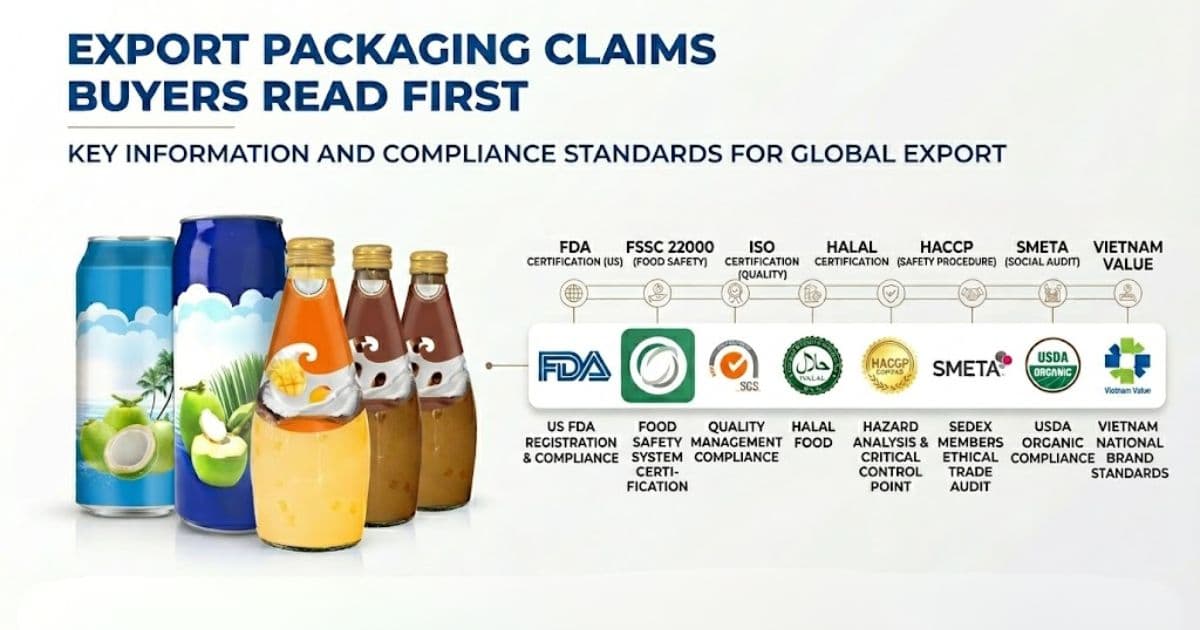
Certifications such as HACCP or ISO function as baseline export beverage quality proof. However, they are only effective when supported by clear documentation. Product specifications, ingredient lists, and certification summaries must be complete and easy to access. Poor documentation can weaken trust, even when certifications are present.

Packaging and Labeling as Tangible Product-Quality-Signals
Packaging integrity is a direct reflection of operational quality. European buyers pay attention to seal reliability, print clarity, barcode readability, and date coding accuracy. At the same time, label clarity matters. Overstated claims or unclear product descriptions can quickly reduce credibility. In the EU market, disciplined and transparent labeling is itself a strong quality signal.
Translating Product-Quality-Signals into Commercial Trust and Buyer Confidence
Ultimately, quality expectations in EU beverage trade go beyond the product itself. Buyers look for a combination of consistency, proof, and clarity across all touchpoints. Brands that communicate these signals effectively are seen as reliable partners, not just suppliers.
Conclusion: Building Market Trust Through Consistent Product-Quality-Signals
In European trade, product quality is not judged by a single factor but by a system of consistent and verifiable signals. From packaging and labeling to documentation and portfolio structure, every detail contributes to how buyers perceive reliability. For beverage brands, improving product quality signals in European trade is not just about compliance—it is about reducing risk for buyers and accelerating decision-making. Brands that present quality clearly and consistently are more likely to move from initial interest to long-term partnerships.
At Nam Viet Group, these principles are applied through consistent product development, export-ready documentation, and structured portfolio presentation for international markets.